Flowchart from the video, and its creator Mike Curtis
Mike Curtis of the Henry George Academy has produced a series of ten videos presenting the essentials of Progress & Poverty, in a modern context. While it can’t provide the interactivity of a real-time course, it explains the important points clearly, backed up by illustrations and 21st-century data. It also provides considerable detail about how land values are assessed in Arden. The videos are on youtube and can be accessed here. In the event of youtube difficulties, the set has also been placed on the Internet Archive, beginning with Lesson 1 here.
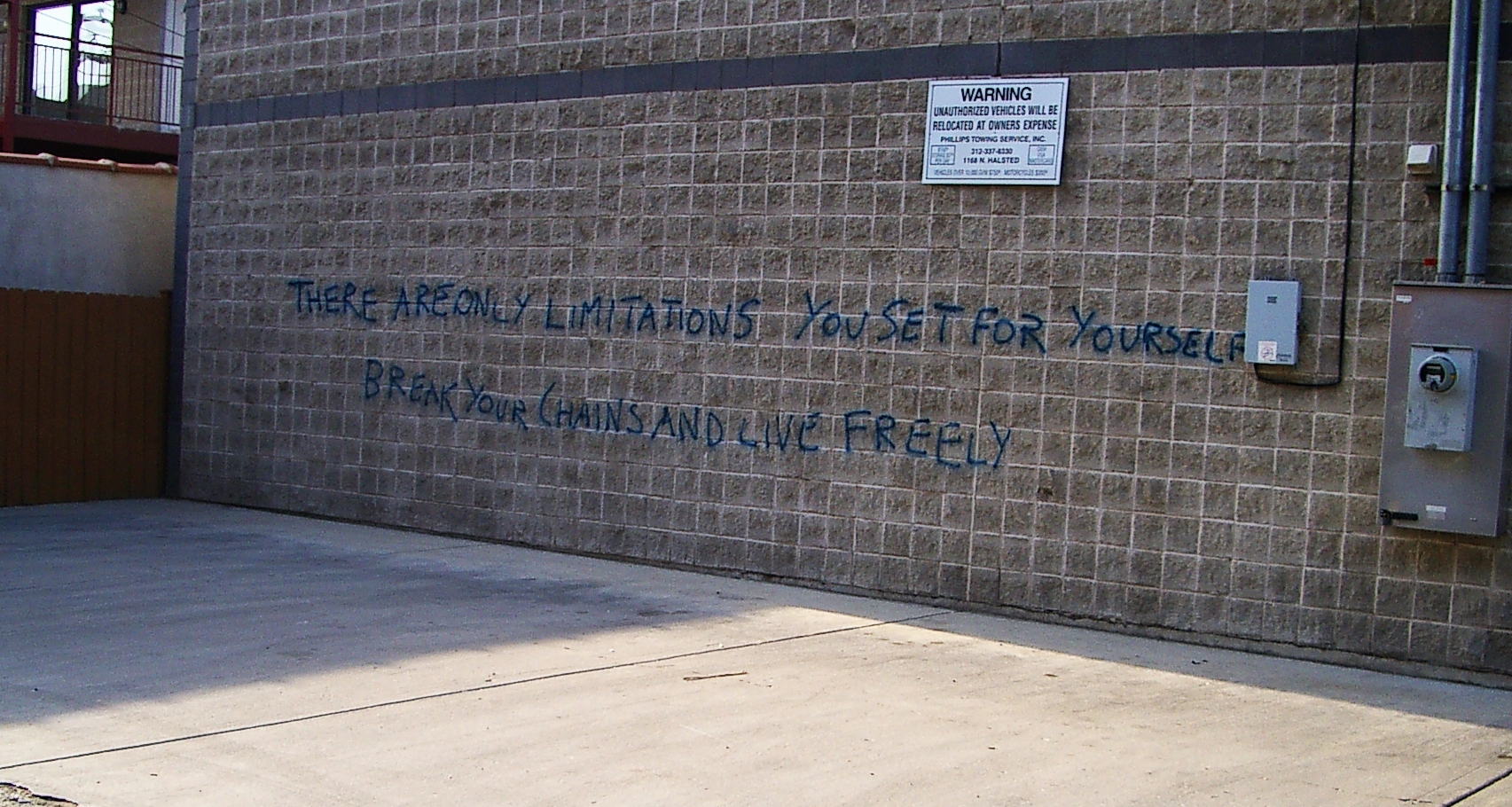
Indeed, all wealth is produced by labor. mage credit: Neal Jennings (CC BY-SA 2.0)
We’re fortunate that Henry George’s ideas, and proposals based on them, are propagating. The two-rate tax, long seen only in a few Pennsylvania places, is getting serious consideration in several other states. The Progress & Poverty Institute, along with the Center for the Study of Economics, have built useful tools for explaining the benefits of buildings at a lower rate than land, or perhaps exempting buildings from taxation altogether. Public Revenue Education Council helps legislators, government staffers, and activists understand how land value tax can alleviate problems that they face. From those sites (and other links on ours) you can find an impressive range of information about how our tax system could be improved to promote, as one state’s motto says, “liberty and prosperity.”
So what is the role of the Henry George School? We, along with our colleagues on the island, and at the Henry George Academy, teach the full range of George’s ideas. Certainly a shift of tax from improvements to land is part of it. But fundamentally, George is about privilege, monopoly, justice and opportunity. We can discuss the details of George’s writings, how today even more than in the 19th century they could lead to a just and prosperous community, and even (in an advanced course) where he was seriously wrong.
If this appeals to you, attend our (free) Introducing Progress & Poverty session on Tuesday, June 9, starting at 5:30 PM. We’re at 333 S Wabash #2700, Chicago 60604. (The landlord requires that you register in advance and present identification for entry. If this is a problem for you, contact us to discuss options.) To register, or for further information, email us or phone 312 362 9302. At this session, you’ll have to opportunity (but not the obligation) to sign up for our complete Progress & Poverty course starting the following week.
That was one student’s comment regarding our Progress & Poverty course. While the complete course requires several sessions and some reading, we outline most of the key ideas in our one-session “Introducing Progress & Poverty.” You will learn a groundbreaking theory explaining why poverty persists, see how it applies today much as it did when Henry George was writing more than a century ago.
This session meets Wednesday, March 18, 5:30 PM in our conference room at 333 S Wabash #2700, Chicago. Everyone is welcome to attend, but our landlord requires that you register in advance, by by emailing us, and you’ll need to show ID when entering (If this is a problem for you, email us for other options.)
After this free introductory session, a full Progress & Povertycourse will be scheduled for those interested.
Sunrise – Chicago, Illinois USA by UltraView Admin via Flickr Attribution-ShareAlike 2.0 Generic CC BY-SA 2.0
Our popular and free Introducing Progress & Poverty session will be presented on three Tuesdays this month, August 12, 19th and 26th. Any session will provide an overview of the main concepts in the Progress & Poverty book, in which Henry George identifies the principal reasons why poverty persists even as technical progress massively increases our capability to meet human needs. Of course the specifics are different– progress in George’s time was the railroad, steam, and electricity, whereas today it’s the internet, mobile phones, and artificial intelligence. But the fundamental causes are not different.
Introducing Progress & Poverty will help you understand why it is so difficult for ordinary people, willing and able to work, to make a decent living, and will present for your consideration Henry George’s proposal for solving the problem.
Each session starts at 5:30PM, at our Signature Office space, 333 S Wabash #2700. Both sessions are free, but building management requires that everyone be registered and present ID. You can register by emailing us . (If the ID requirement is a problem for you, email us to discuss other options.)
The August 12 and 26 presentations will be by HGS instructor Chuck Metalitz. Instructor George Menninger will present on August 19, drawing on his real-world experience applying some of the economic principles we teach.
For a more complete understanding of basic economic principles, enroll in our full Progress & Poverty course, which will begin September 9, continuing on Tuesdays thru November 4. You can register for it at any of the three introductory sessions.
Chicagohenge (image credit: Erik Cooper CC BY 2.0)
Our popular Introducing Progress & Poverty session will be presented on two Tuesdays this month, May 13 and May 20. Either session will provide an overview of the main concepts in the Progress & Poverty book, in which Henry George identifies the principal reasons why poverty persists even as technical progress massively increases our capability to meet human needs. Of course the specifics are different– progress in George’s time was the railroad, steam, and electricity, whereas today it’s the internet, mobile phones, and artificial intelligence. But the fundamental causes are not different.
Because tariffs and international trade policy have been in the news recently, we’re upgrading the presentation to include consideration of how tariffs work, what they aim to accomplish, and a more effective way to accomplish their asserted purpose.
Introducing Progress & Poverty will help you understand why it is so difficult for ordinary people, willing and able to work, to make a decent living, and will present for your consideration Henry George’s proposal for solving the problem.
Each session starts at 5:30PM, at our Signature Office space, 333 S Wabash #2700. Both sessions are free, but building management requires that everyone be registered and present ID. You can register by emailing us . (If the ID requirement is a problem for you, email us to discuss other options.)
For a more complete understanding of basic economic principles, enroll in our full Progress & Poverty course, which will begin June 3, continuing on Tuesdays thru July 29. You can register for it at either the May 13 or May 20 session.
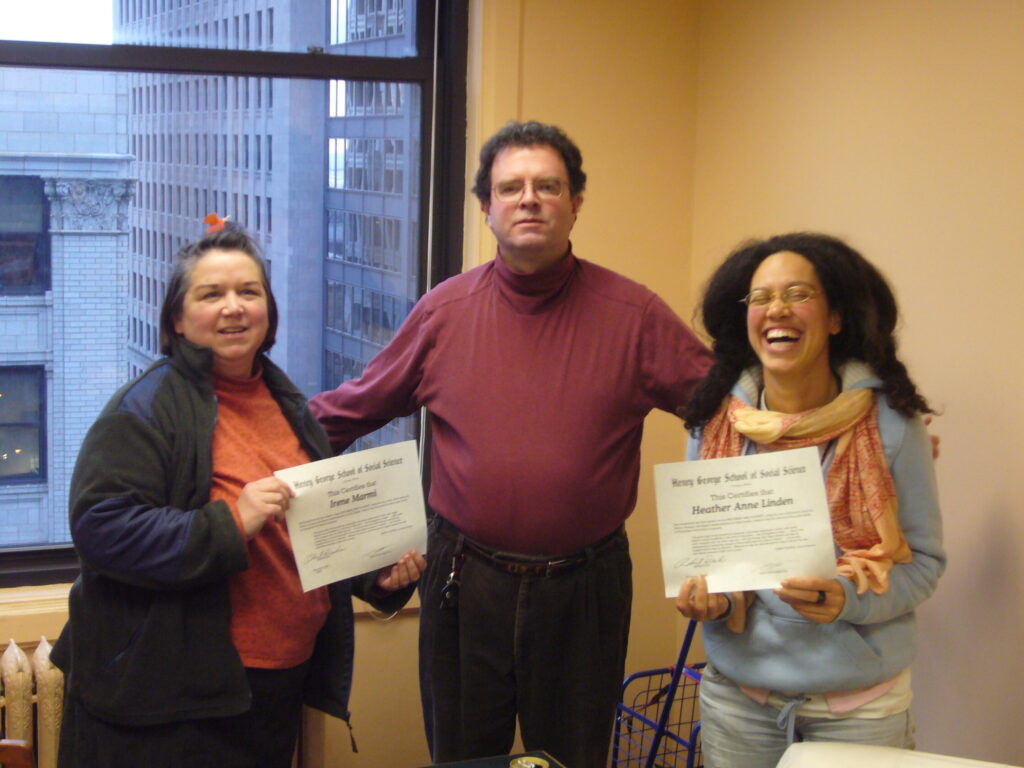
Irene Marmi (left) receives her graduation certificate from late Progress & Poverty instructor Bob Drake in 2008. Fellow graduate Heather Anne Linden at right.
Our good friend and long-time Henry George School of Chicago board member and librarian Irene Marmi has died. She died on May 5, 2025.
She was a delightful woman who had taken care of a number of elderly women until she herself was no longer able to do that work as her own health had deteriorated. She was also a friend of Bill Wendt’s and helped him during the last years of his life. She was always empathetic, and had an easy manner in talking to people she simply encountered during the ordinary course of life. She introduced any number of people to Georgism, who then attended the School’s presentations or took classes. Irene will also be remembered as a feral cat activist.
We should all have a kind and caring friend like Irene.
The popular “Introducing Progress & Poverty” session will be presented on two Tuesdays this month, March 18 and March 25. Either session will provide an overview of the main concepts in the Progress & Poverty book, in which Henry George identifies the principal reasons why poverty persists even as technical progress massively increases our capability to meet human needs. Of course the specifics are different– progress in George’s time was the railroad, steam, and electricity, whereas today it’s the internet, mobile phone, and artificial intelligence. But the fundamental causes are not different.
This is recommended for anyone who plans to take our Progress & Poverty course, which starts April 1, as well as for anyone concerned in social and economic justice.
Each session starts at 5:30PM, at our Signature Office space, 333 S Wabash #2700. Both sessions are free, but building management requires that everyone be pre-registered and present ID. You can register using our Eventbrite listing for March 18 or March 25, or by emailing us . (If the ID requirement is a problem for you, email us to discuss other options.)
Our full Progress & Poverty course will begin April 1, continuing on Tuesdays thru May 27. You can register for it at either the March 18 or March 25 session.
If you’re concerned about problems of poverty, lack of opportunity, and declining quality of life in Chicago and America, and hoping for a better future, you should attend ourIntroducing Progress & Poverty session on Tuesday, January 14, 5:30PM. Perhaps you already knew that these problems aren’t unique to our time, but were recognized in the 1870s (and earlier) by Henry George among others. George synthesized an explanation and proposed a solution which could be even more effective today than in his era.
This session is without charge or obligation, but requires preregistration. If you find it of compelling interest, you might want to enroll in our complete Progress & Poverty course, which continues thru March 18.



 “Big Tent Urbanist Event” is presented by the