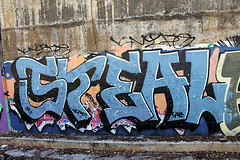
“Headed to Work” by Andrew Becraft (cc) via flickr
This is not the history of labor unions, tho they are certainly included. It’s broader than that, the history of how Americans have made a living over the centuries. The main (but not the only) text is Henry George’s Social Problems, a very accessible work, which does not presuppose any particular understanding of political economy. More about the course is here. Meets for ten weeks, every Tuesday thru November 19. Preregistration is available here, or just show up and sign up after the first class. $25 fee covers the entire course. For more information, email the instructor or phone 312 450 2906.
Leading up the the 2013 Monetary Reform Conference, Bob Jene will examine the American Monetary Institute‘s proposed Monetary Reform Act. This amendment to the U S Constitution will be compared to Henry George’s ideas on money. Steve Zarlenga‘s analysis of Henry George’s ideas, showing George was an important monetary reformer, will also be discussed. (Zarlenga is author of The Lost Science of Money.)
At 30 E Adams #1207, free, donations welcome. For further information email Bob Jene or phone 312 450 2906.
Successful land speculation is really a matter of capturing for yourself the gains that belong to the community. George Menninger is one of many who have done it. Far beyond any need to earn a living, George now spends some of his time explaining how the bad public policy he exploited not only made him rich, but led to continued poverty, unemployment, and even the recent economic meltdown. “I’ve made piles of money using the principles taught at the Henry George School,” he says. “Sure, it’s stolen money, but if I didn’t steal it, somebody else would.”
George’s talk is titled “How I Made $1 million in Chicago Real Estate: I $tole it from You” and will be next presented on Thursday, September 12 at 6 PM, at 30 E Adams St. #1207. It’s free and open to all. It’s also the first session of our Progress & Poverty course (modern version), which will continue on Thursdays thru October 10. As with all our courses, the $25 registration fee need not be paid until the end of the first session, and the instructor will provide a personal and accessible explanation of Henry George’s ideas. You can pre-register here, or just show up. You are also welcome to attend just this session; there is no obligation or expectation that everyone attending will enroll.
Should you wish additional information, call (312 450 2906) or email us.
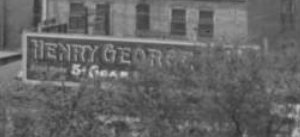
The Political Economy Book Club takes up Henry George, Jr‘s biography of his father. Junior was a skilled writer and professional journalist, important in the single tax movement, and a political activist who served two terms in the U S House of Representatives. The book is available at some public and university libraries and used copies can be inexpensive. Free downloads of the text are available here and here.
The September discussion (at 30 E Adams #1207) will cover the first part (“Formation of the Character”) of the book. The event is free, though donations to help pay the rent are appreciated. PEBC convenor Bob Matter would appreciate an RSVP by email or phone (312 450 2906) if you hope to attend, and can answer any questions.
Our annual end-of-summer gathering to celebrate the year and look forward to another. Share ideas and thoughts picked up (or dropped off) at the CGO conference. Discuss plans for the fall term and beyond. Watch some Georgist videos. Enjoy whatever food our potluck has brought, along with suitable drinks in a relaxed atmosphere in heavily-taxed Evanston. We gather from about 3 PM and tend to leave by dark.
If you’d like to attend, contact Sue Walton no later than Friday (Aug 30) at 847 475 0391. Everyone is asked to bring some food and contribute $5 (Sue will advise on what is needed), new graduates excepted.
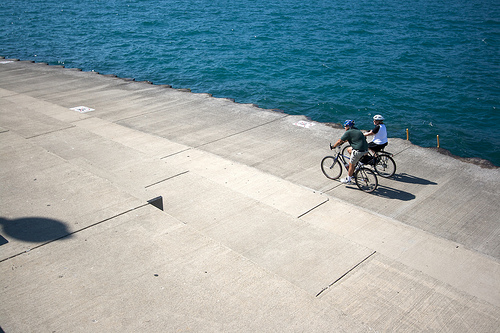
Photo of cyclists along the near south lakefront by Marcin Wachary (cc) via flickr
This tour looks at the lakefront areas just south of the Chicago loop, including the Central Station, Museum Campus, and Prairie Avenue districts. We’ll see how the natural and manmade amenities affect what sites are worth, and how this is (or is not) reflected in assessments.
This area has undergone numerous changes over the decades, from residential to commercial, railroad, industrial, institutional, and back to residential, but always the lakefront and close access to downtown have been important. The land has long been valuable, and we’ll talk about the factors which produce value and who benefits from it.
There is no charge for the tour (altho donations will be gratefully accepted). We leave from 30 E Adams at 2 PM. Bring your own bike. Optional RSVP to 312 450 2906, or email tour leader Bob Jene
Originating as a field trip for “Progress & Poverty” students, our Invisible Robbery Tour is now open to all.
See how the community and its infrastructure produce value.
See who collects this value, and how it affects us all.
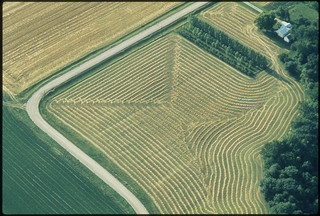
Credit: Viewminder via flickr (cc)
We’ll stroll about two kilometers, in about an hour and a half. You’ll get detailed, sourced, hardcopy notes, and answers to your questions about how downtown development really works.
The tour is free for HGS graduates and anyone who has paid an HGS registration fee within the past two years, as well as for current donors at the member level. Others are requested to donate $10, which may be done by cash, check or credit card. (Of course you can always donate to the Henry George School; donations of any amount can be done here.)
We’ll leave from the Henry George School location, 30 East Adams #1207. Call 312/450-2906 or email if you want any more information.
Bughouse Square in the old days (source: Wikimedia)
Bob Matter and his crew of merry geoists will have a table at the Bughouse Square Free Speech Forum on Saturday, July 27. Stop by, get the latest info about the School, argue with him a bit (but not too much, ’cause he gets articulate under stress), listen to the speakers and maybe visit some of the other interesting groups who participate. Of course it’s entirely free, sponsored by the Newberry Library. Washington Square Park, Dearborn & Walton. 1 to 4:30 PM, Saturday, July 27. For more information, or if you want to help, call 312 450 2906 or email Bob Matter
Since earliest civilizations, humans have recognized that food is a product of farmland (and, yes, pastureland, fisheries, etc) and have managed to cultivate enough land to feed themselves. Yet today we routinely convert farmland to urban use. American Farmland Trust (AFT) seek to ensure continued agricultural use of some land by buying development rights from farmers, and try to make farms more viable by facilitating community supported agriculture. The geoist fiscal reform provides an alternative way to encourage more conservative and productive use of all land. This presentation by HGS instructor Bob Jene suggests that an alliance between AFT and geoists might benefit both.
Thursday, July 25, 6 PM, at 30 E Adams #1207. Free and open to all. Have you questions, or would like to let us know you’re coming, call 312 450 2906 or email Bob Jene
This is a four-session course, based on the book by John Kelly. Kelly approaches the problem as a believing Christian (but the idea is equally of interest to those of other or no religion): Does “God” (such as s/he may or may not be) care about economics? Kelly finds that his Bible contains a prescription for prosperity with freedom and natural equality.
Thru this course, you can evaluate the idea for yourself, and decide whether Christianity (or any of the related religions) has anything insightful to say about how should organize our economies.
This is the same course that was formerly titled “Economics as if God Cared;” we have retitled it in hopes of offending everyone equally. No outside reading is required for this course, everything being presented in the class by instructor Bob Jene. It’s open to everyone without prerequisite. The course meets Tuesdays, July 9 thru July 30, and you can register here or by phoning 312 450 2906. The only charge is a $25 registration fee.