An inquiry into the Nature and Causes of the Wealth of Nations, generally referred to by its shortened title The Wealth of Nations, is the magnum opus of the Scottish economist and moral philosopher Adam Smith. First published in 1776, it is a reflection on economics at the beginning of the Industrial Revolution and argues that free market economies are more productive and beneficial to their societies. The book is a fundamental work in classical economics. Henry George disputed some of Smith’s reasoning, but described him as the “founder” of the science of political economy.
This session will discuss the first half of Book I.
Political Economy Book Club meets 6 PM Wednesday, December 14, at 28 E. Jackson #1004. Free, donations, welcome.
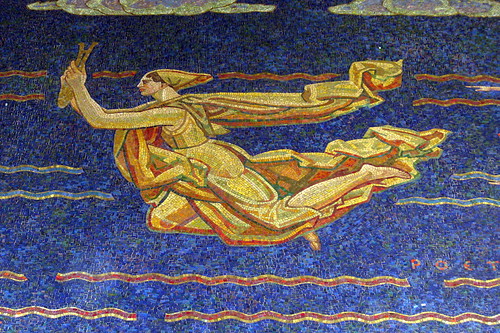
Image at Rockefeller Center, NYC. Photo credit: WallyG via Flickr (cc)
[The following, originally posted in December, 2011, remains relevant and has received minor edits.]
The mission of the Henry George School is to make available to everyone an education in political economy and social philosophy, based primarily on the works of Henry George. Anyone who understands George’s ideas knows the cause of poverty, and knows what must be done to eliminate it.
But progress depends on widespread knowledge, and our School has very limited resources for making people aware of what we offer. With one exception (who earns a sub-poverty wage), everyone working for the School is a volunteer. Past and present supporters provide us enough for rent, supplies, and very minimal advertising. Additional help is needed to improve the manner in which our message is presented, and make it more broadly known.
December is the traditional time for making monetary donations, and the Henry George School welcomes contributions of any amount. We are recognized as a 501/c/3 charitable organization, so donations can be tax-deductible, and donors can be formally recognized by our membership program(pdf). Donations can be made by credit card, or by check mailed to the School (Henry George School, 30 E Adams St. #1207, Chicago 60603). Although we do not maintain a corps of smooth-talking gift planners devoted to estate planning matters, we are able to assist in setting up tax-advantaged gifts for those who may be in a position to participate in them.
In addition to monetary donations, we solicit the assistance of volunteers in all aspects of our work. Help is needed with promotion, design, office operations, archives, and all kinds of special projects. Just let us know what you might like to do.
“Responsible” politicians and pundits say that we face a tradeoff among higher taxes, reduced government services, and more public debt, lest current trends lead to ruinous inflation resulting in all three. Those aren’t the only choices, and certainly not the best ones, asserts HGS instructor Chuck Metalitz. Raising taxes on production leads economies to a downward spiral, but shifting taxes off of production can bring prosperity while raising needed revenue. And if public debts have become too big to pay, then perhaps it is best not to pay them. The problem is that holders of privilege largely escape taxation, while keeping the rest of us ignorant of the fundamentals of political economy.
Tuesday, December 13, 6 PM at 28 E Jackson #1004. Free, donations welcome.
Attempts to “tax the rich” have led us to exempt about half the population from paying federal income tax, while creating all kinds of other levies that discourage production while falling heavily on working people. But if we look at who “the rich” really are, and where most of their income originates, we see that, rather than focusing on the amount of a person’s income, we could instead look at the source. Producing goods or services that people want– that increase the overall satisfaction in the community– is fundamentally different from securing, protecting, and manipulating privilege. Chuck Metalitz will explain what privilege is, how it causes wealth to be concentrated in a small part of the population, and what could be done about it. 6:00 PM at 28 E. Jackson #1004. Free, donation welcome.
Our last Progress & Poverty course of 2011 is an afternoon class, starting Thursday, Nov 17, 2:30 PM, at 28 E. Jackson. This is the modern version, just five class sessions to understand the nature of wealth and the principles which determine who gets it– and who doesn’t.
Instructor for this section will be Bob Jene. As always, you’re welcome to sit in on the first session before deciding whether to register and pay the $25 fee. The fee covers the entire course and includes a double-money-back guarantee. You can pre-register here. Call or email if you have questions.
Of course we’ll teach Progress & Poverty again starting in January.
Urban sprawl threatens to destroy much valuable farm land. We will look at data from one of the leading national organizations trying to mitigate this damage, The American Farmland Trust (AFT). Among other things they buy development rights from farmland owners to ensure the land’s continued use in agriculture, and facilitate community supported agriculture, which makes family farms more viable. The Georgist fiscal reform encourages more conservative and productive use of all land.
Presentation by HGS instructor Bob Jene, Wednesday November 16, 6 PM at 28 E Jackson #1004. Free. Information at: 312 362 9302.
What is the best policy to revive the economy and improve the incomes of working people? Bailing out insolvent banks, and asking them to lend more money? Taxes on consumption? Simplify the income tax and flatten the rates? Or just print a bunch of money?
HGS instructor Bob Jene knows the answer (which is “no”) and will explain how a real fiscal stimulus could work. Will the Real Fiscal Stimulus Please Stand Up?, Thursday, November 10, 6 PM, at 28 E. Jackson #1004. It’s free, of course, donations welcome to help pay the rent. Need any more information? call Continue reading “Fiscal Stimulus?”
This bicycle tour will look at the city parks developed on both banks of the Chicago River. We will cycle through the intense development of the old Chicago Dock and Canal property on the north side of the river facilitated by the $35 million bascule bridge on Columbus Drive which made the property much more accessible. This was all on the taxpayers’ dime. Finally we will stop at Trump Tower before heading back. Bob Jene is your guide.
Bring your own bike to this free cycle tour which departs 28 E. Jackson at 1 PM on Saturday, October 22, 2011. For further information contact Bob Jene at 312 362 9302 or bobj@hgchicago.org.
We have one more section of Progress & Poverty, Thursdays beginning November 17 (except Thanksgiving). See the schedule here and course description here. More sections will be offered in 2012, of course.
Another option is on-line instruction thru the Henry George Institute. HGI assigns an individual instructor for each student, and some of these instructors are the same folks who teach at various Henry George Schools. Individual tutorials in Chicago can also be arranged.
If geography is your constraint– you can’t get to downtown Chicago for classes– consider sponsoring a Progress & Poverty course in your neighborhood. You secure a location and help promote the class. We provide an instructor and materials, and can also furnish limited funds to defray site costs and local advertising. Contact us if you’d like to explore this option.